
How to Price Your Tech Services as a Nigerian Freelancer: Value-Based Rates, Taxes, and Negotiation Tactics
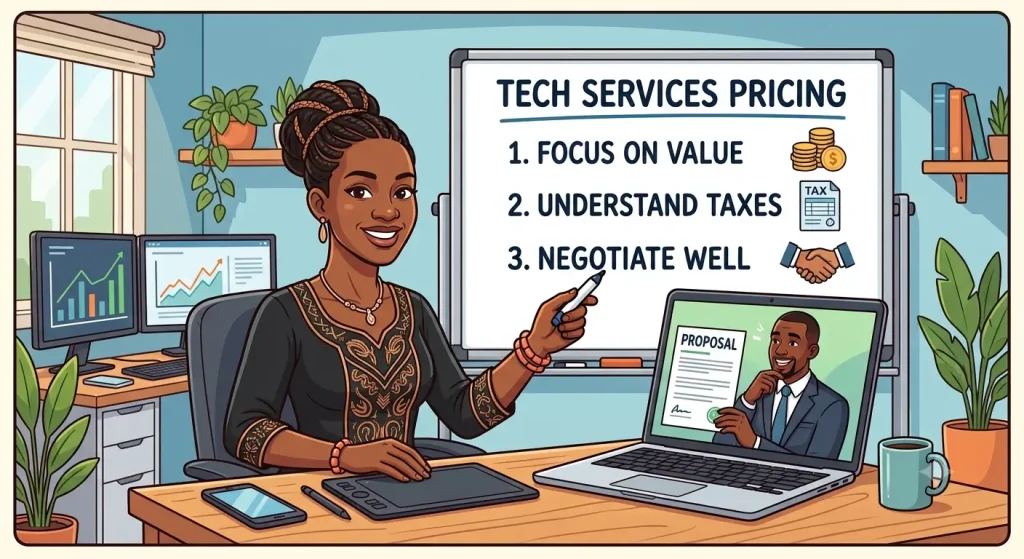
You did the hard work to become a skilled developer, designer, or cloud engineer. Now the hard part is putting numbers next to that skill and getting paid what you deserve. This guide walks you through value-based rates, Nigerian tax realities, and negotiation tactics that convert prospects into steady clients.
Start with a mindset shift: price outcomes, not hours
Clients do not pay for time. They pay for results. A site that converts 3x more visitors or an API that saves a company thousands of Naira each month is value. When you frame your service as measurable impact, your rates stop being a price per hour and become a share of the value you create.
Value-based pricing lets you charge according to client ROI. That usually translates to higher revenue, fewer clients to manage, and better long-term relationships.
Benchmark the Nigerian market and international demand
Know the going rates locally and globally. Nigerian startups and small businesses pay differently from international clients. Check platforms like Upwork, LinkedIn, and local job boards for project rates. Talk to peers in Slack channels and developer communities to confirm real-world numbers.
Segment clients by budget and willingness to pay. Enterprises and foreign startups often accept value-based fees. Local SMEs may prefer fixed or milestone payments.
How to calculate value-based rates in three steps
- Identify client outcomes. What is the measurable benefit? More users, reduced costs, faster time-to-market.
- Estimate the monetary impact. Convert outcomes into currency. For example, a 20% increase in conversion on a product that makes N1,000,000 monthly equals N200,000 extra revenue.
- Capture a fair share. Decide the percentage of that impact you will charge. A common range is 10 to 30 percent for direct revenue gains. For cost savings or intangible benefits, justify a higher flat fee or success bonus.
Write this calculation into your proposal. Clients respect logic that ties pricing to business impact.
Practical formulas and examples
- Hourly baseline: calculate your break-even hourly rate first. Include living costs, software, equipment, taxes, and a profit margin. Example: (monthly expenses + desired profit) / billable hours.
- Project value price: Project price = Estimated client benefit x Your share percentage.
- Hybrid approach: Base retainer + success fee. Base covers your costs and reduces risk. Success fee aligns incentives.
Example: A client earns N500,000 monthly from an app. You estimate a 25 percent uplift = N125,000. Charging 20 percent of that uplift yields N25,000 monthly as your fee. Add a one-time implementation fee to cover setup.
Handling risk and scope creep
Always define metrics, timelines, and what constitutes success. Use milestones and acceptance criteria. Add a change order process and hourly rate for out-of-scope work. This protects your margins while keeping clients accountable.
Taxes and compliance for Nigerian freelancers
Freelancers must plan for taxes and compliance. Key items to know:
- Personal Income Tax: If you operate as a sole proprietor, you pay personal income tax to your state. Rates are progressive. Keep income records and file annually.
- VAT: If your turnover exceeds the VAT registration threshold, you must register for VAT with FIRS. Services supplied to local clients may attract VAT. Exported services to foreign clients can be zero-rated if properly documented.
- Withholding Tax: Some clients may deduct withholding tax on payments. Know the applicable rates and obtain tax credit certificates to avoid double taxation.
- Company structure: Registering a limited company affects tax treatment. Company Income Tax rate applies, and you can pay yourself salary or dividends with different tax implications.
Keep digital records of invoices, receipts, and bank statements. Use accounting software or a bookkeeper familiar with Nigerian regulations. Missing compliance can eat your profits and cause legal headaches.
Invoicing and payment methods that reduce friction
Offer multiple payment options: local bank transfers, US Dollar transfers, Payoneer, Wise, and crypto where acceptable. Always state currency, VAT applied, payment terms, late fees, and invoice due date.
Use clear invoices that show the value delivered, not just hours. For international clients, specify who pays transfer fees. Consider upfront deposits: 20 to 50 percent for new clients.
Negotiation tactics that win and protect your rate
- Anchor high, then justify. Start with a higher figure and immediately present the business impact behind it.
- Offer choices. Present three packages: basic, standard, premium. Clients often pick middle or premium when options are framed clearly.
- Use time-limited proposals. A proposal valid for 7 to 14 days prevents scope drift and shows urgency.
- Trade concessions smartly. Give smaller discounts in exchange for longer contracts, faster payments, or references.
- Practice silence. After you state your price, pause. Let the client react first. You gain bargaining power.
- Walk-away power matters. Be ready to decline projects that undercut your minimum rate. Saying no preserves reputation and earns respect.
Negotiation examples for tech projects
- Fixed-price build: Quote a base fee for full delivery, define milestones, require 30 percent upfront, 40 percent on staging, 30 percent on launch.
- Retainer + success fee: Monthly retainer for maintenance + 15 to 25 percent of incremental revenue tied to KPI improvements.
- Time and materials with cap: Hourly billing up to an agreed maximum. Anything above requires written sign-off.
Tailor the approach to client risk tolerance and project predictability.
Communicating value in proposals
Lead with outcomes and evidence. Use brief case studies, testimonials, and numbers. Show before-and-after metrics to make value tangible. Keep sentences punchy and the proposal scannable with clear pricing tables.
End the proposal with a clear call to action and next steps. Include a short FAQ to address common objections.
Typical rate ranges to guide you (2026 reference)
- Junior developer / designer (local startups): N5,000 to N25,000 per hour or N50,000 to N400,000 per project.
- Mid-level specialist: N25,000 to N75,000 per hour or N400,000 to N2,000,000 per project.
- Senior engineer / architect, DevOps, data specialist: N75,000 to N200,000 per hour or N2,000,000+ per project.
- International clients: multiply local rates by 2 to 5 depending on niche, reputation, and proven results.
Adjust for complexity, urgency, and client size. These numbers are guides, not rules.
Build a pricing playbook and iterate
Record what works: proposals that win, negotiation tactics that close, and clients who pay on time. Track conversion rates and average contract value. Raise prices for new clients when your win rate stays healthy.
Treat pricing as an experiment. Test, measure, and refine.
Final thought
Pricing is both arithmetic and storytelling. The numbers must cover your costs and reward your skill. The story ties those numbers to client outcomes so they accept the price willingly. Get both right and you turn freelance expertise into sustainable income.