
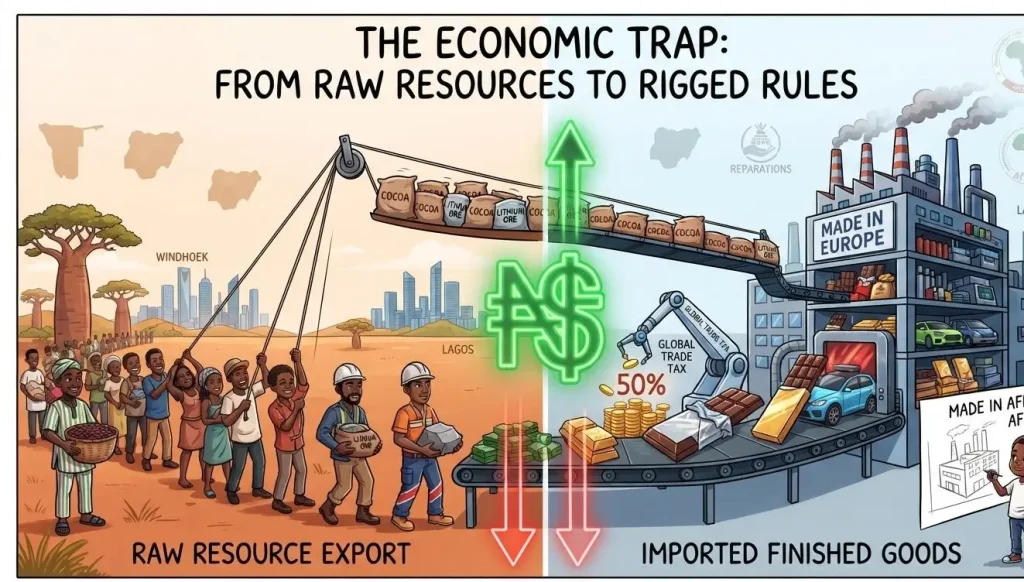
If you think Africa’s economic struggles are solely the result of “bad governance” or “corruption,” you are only seeing half the picture. While internal leadership issues are real, the global financial system itself was deliberately engineered to ensure Africa remains a raw material farm for Western superpowers. From the stark urban wealth divides in Namibia to the hidden traps of global agricultural trade, the rules of international commerce are actively rigged against African industrialization.
To truly understand how this system functions, we have to look at the structural machinery keeping the continent economically bound.
1. The Spatial Segregation of Wealth: From Apartheid to Today
One of the most visible and painful expressions of this global imbalance can be found in Windhoek, the capital city of Namibia. Visitors are often shocked by the contrast: within a 15-minute drive, affluent, historically White suburbs like Ludwigsdorf and Klein Windhoek, filled with modern mansions and manicured streets, give way to the crowded township of Katutura.
Katutura literally translates to “the place where people do not want to live” in the Herero language. It was built in the 1950s by the South African apartheid administration as a segregated zone where Black residents were forced to relocate. Over three decades after independence, the spatial divide persists. Urban migration brings thousands of rural citizens to the capital every year in search of jobs, causing massive informal settlements of zinc shacks to balloon.
Because wealth is inherited across generations, the affluent neighborhoods remain wealthy, sustained by private investment and local property taxes. Meanwhile, the municipality struggles to secure the billions of dollars needed to install grid sewage, electricity, and reliable water lines in informal areas. This creates a vicious cycle of poverty and infrastructure bottlenecks that local community committees continuously fight to dismantle.
2. The Genocide and the Reparations Dispute
The deep economic inequality in Namibia is tied straight to historical atrocities that have never been financially corrected. Between 1904 and 1908, German colonial forces committed what historians call the first genocide of the 20th century, slaughtering over 75,000 Indigenous Ovaherero and Nama people and seizing their ancestral lands.
In 2021, after years of diplomatic pressure, Germany officially acknowledged the genocide and offered €1.1 billion ($1.2 billion USD) spread over 30 years. However, Germany flatly refused to call this money legal “reparations,” labeling it “development aid for reconciliation” instead.
Why the semantic games? Western nations deeply fear that admitting full legal liability for colonial crimes would create a binding precedent, opening the floodgates for other countries (like Britain, France, and Belgium) to face trillions of dollars in lawsuits over historical plunder. Furthermore, inside Namibia, tension remains high because the descendant communities are excluded from direct control of the funds, fearing the central government will absorb the capital rather than distributing it to the specific groups who lost their land and wealth.
Compared to the tens of billions Germany rightfully paid to Holocaust survivors, the tiny offer made to Namibia exposes a glaring international double standard.
3. The Structural Rigging: The Tariff Escalation Trap
The unfairness doesn’t stop at historical trauma; it operates daily through modern international trade laws. Consider the global chocolate industry, heavily driven by West African cocoa from nations like Nigeria, Ghana, and Côte d’Ivoire.
Under a predatory trade mechanism known as Tariff Escalation, the global market ensures African entrepreneurs cannot easily process their own raw materials:
- If Nigeria exports raw cocoa beans to Europe, Europe charges a 0% import tax.
- If a Nigerian entrepreneur processes those exact beans into finished chocolate bars and tries to export them, Europe slaps a massive, punitive tariff on the finished product.
This system forces Africa to remain a seller of cheap “raw dirt and seeds” while buying back high-value processed goods at a premium. By penalizing manufacturing at the customs border, the high-paying factory jobs, technology, and actual profits stay locked in the Global North.
4. The Capital Flight Drain: Who is Funding Whom?
The common narrative is that the West generously supports Africa through foreign aid. The data shows the exact opposite. A landmark study by the United Nations Economic Commission for Africa (UNECA) revealed that the continent loses over $89 billion every single year to illicit financial flows.
Through profit-shifting, trade misinvoicing, and offshore tax evasion, foreign multinational corporations extract minerals, oil, and agricultural products while legally manipulating accounts to avoid paying local corporate taxes. Africa is actually a net creditor to the world, losing far more through illegal financial outflows than it ever receives in global aid or loans. The interest paid back on high-interest development loans further hollows out national budgets, stripping funding from local healthcare, schools, and social safety nets.
5. Flipping the Board: How Africa is Fighting Back
Despite the wickedness of this architecture, a new generation of African youth, entrepreneurs, and policymakers is actively breaking the chains. The tide is turning through deliberate economic pushback:
- Forcing In-Country Processing: In 2023, Namibia banned the export of unprocessed, raw lithium and critical minerals needed for electric vehicles. Zimbabwe passed a similar law. They have sent a clear message to global powers: if you want our resources, you must build the factories here and employ our people.
- Trading Internally (AfCFTA): Under the African Continental Free Trade Area (AfCFTA), African nations are cutting trade barriers between themselves. Instead of fighting European tariffs, an African manufacturer can now target a massive domestic market of 1.4 billion consumers.
- Local Refineries and Artisanal Brands: In Nigeria, the massive scale-up of local refining capacities is cutting out the need to import expensive foreign petrol. Simultaneously, premium local brands like ’57 Chocolate and LoshesChocolate are proving that Africa can dominate the luxury processed goods market.
Turning Frustration Into Action
The historical trap is deep, but the generation taking it down is unified. The fastest way everyday citizens can disrupt this extraction engine is through deliberate purchasing power. By actively supporting local manufacturing, buying homegrown products, and backing regional processing, we build the economic sovereignty necessary to permanently dismantle the trap.
Disclaimer: Financial conversions and exchange rates referenced in this analysis are based on prevailing market rates at the time of evaluation. Real-world commercial banking transactions, money transfer applications, and retail cash exchanges vary based on institutional margins, processing fees, and regional regulatory frameworks. This text is compiled strictly for educational, historical, and socio-economic commentary purposes.