
How to Run a Nigerian Remote Team Like a Startup Founder: Processes, Tools, and KPIs
You can build a high-performing remote team in Nigeria that moves with the same speed and focus as a tight startup crew. This is about blending hustle culture with systems, clear communication, and the right metrics. Read on for a practical playbook that covers processes, tools, and KPIs tailored to the Nigerian context.
Start with a founder mindset
Treat your remote team like a product. Define a mission that is clear, simple, and repeatable. A founder mindset means prioritizing outcomes over busyness, iterating quickly, and making decisions with limited information.
Hire for output, not hours
Write role-first job descriptions that list outcomes and weekly outputs. Use short paid trials or project sprints to evaluate real work instead of long interviews. In Nigeria, emphasize proven problem solving, effective written English, and time-zone flexibility.
Core processes to run daily operations
1. Weekly sprint planning and a single source of truth
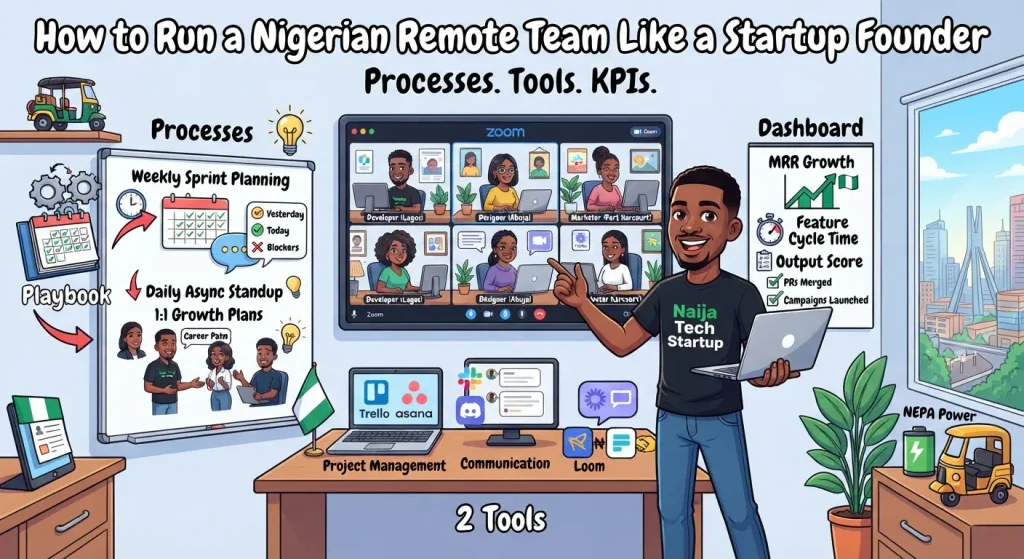
Run a weekly sprint planning session where tasks are sized and owners assigned. Keep every task in one place, ideally a single project board. This prevents duplication and keeps remote teams aligned with what actually matters.
2. Daily async standups
Use a structured async standup: what I did yesterday, what I will do today, blockers. Keep entries concise and time-boxed to five minutes per person. Async standups respect different internet reliability and allow overlap across Nigerian time zones.
3. Clear escalation and decision rules
Document who decides what and by when. For example, product decisions by founder, engineering trade-offs by tech lead, hiring approvals by operations lead. When roles are clear, teams move faster and avoid endless threads.
4. Knowledge capture and onboarding flows
Create short onboarding playlists: company values, operating norms, tech stack, and first-week tasks. Capture meeting notes, decision logs, and templates in a searchable knowledge base. New hires should be productive in 14 days, not 90.
5. Focused 1:1s and growth plans
Hold biweekly 1:1s with clear agendas: wins, growth, blockers, career goals. Use these to surface hidden blockers like poor internet, electricity issues, or family responsibilities. Build growth plans that tie personal goals to company outcomes.
Tools Nigerian remote teams actually use
Communication and async work
- Slack or Discord for chat. Create channels by project and keep general channels minimal.
- Loom for quick video updates when explaining complex ideas saves time and avoids long messages.
Project management and docs
- Trello, Asana, or ClickUp for sprint boards and tasks. Choose one board as the single source of truth.
- Notion or Google Docs for knowledge base and templates. Use consistent naming and a simple folder structure.
Time, payroll, and payments
- Toggl or Clockify for tracking billable time in client-facing teams. Keep usage optional for trust-based cultures.
- Flutterwave, Paystack, or Wise for payroll and cross-border payments. Automate monthly payments and keep transparent records.
Collaboration and product work
- Figma for design collaboration with comments and version history.
- GitHub or GitLab for code with pull request templates and enforced reviews.
Monitoring and uptime
- UptimeRobot or Better Uptime for website monitoring.
- Health checks or simple cron jobs to verify critical services.
KPIs that matter for a Nigerian remote startup team
Split KPIs into company-level, team-level, and individual-level. Keep the dashboard visible to everyone.
Company level
- Monthly Recurring Revenue (MRR) growth rate. Track net new revenue and churn.
- Gross margin. Revenue minus direct costs measured monthly.
- Burn runway in months. Monthly burn and cash runway determine hiring cadence.
Team level
- Feature cycle time. From ticket creation to production release measured in days.
- Support SLA adherence. Percentage of tickets resolved within target time.
- Customer satisfaction (CSAT). Short post-ticket surveys for quality signals.
Individual level
- Output score. Predefined weekly outputs per role, for example, PRs merged, user stories completed, campaigns launched.
- Quality metric. % of work accepted without rework or number of bugs per release.
- Reliability index. Attendance at key syncs, responsiveness in async channels, and task completion rate.
Typical playbook for the first 90 days
Days 0 to 14: Set up and alignment
Define mission, top 3 quarterly goals, sprint cadence, and core tools. Run onboarding sprints and a 14-day trial task for each new hire. Ensure payroll and communication channels are tested.
Days 15 to 45: Build rhythm
Hold three sprint cycles, refine templates, and lock down metrics. Start running weekly metrics reviews and short retrospectives. Fix the biggest blocker identified in the first two weeks.
Days 46 to 90: Scale and optimize
Automate recurring work like payroll, reporting, and backups. Hire only for roles that will unblock the next growth milestone. Move from founder-driven decisions to documented decision rights.
Handling common Nigerian remote team challenges
- Electricity and internet instability: Encourage flexible schedules, backup data bundles, and co-working stipends. Use async-first communication to avoid real-time dependency.
- Payment delays and FX issues: Batch payroll, use reliable local payment providers, and set transparent payment dates. Keep a small local buffer for emergency top-ups.
- Trust and accountability: Measure outcomes, not logged hours. Celebrate small wins publicly and document missed commitments with follow-up plans.
Practical templates to copy
- Weekly sprint template: Goal, three priorities, owner, due date, blockers.
- Async standup template: Yesterday, Today, Blockers, Need from whom.
- PR template: Summary, Linked issue, Test plan, Impact, Reviewer checklist.
Closing operating principles
Move with urgency but keep things simple. Prioritize a single source of truth, short feedback loops, and measurable outcomes. When systems exist, hustle becomes sustainable and teams scale without chaos.