
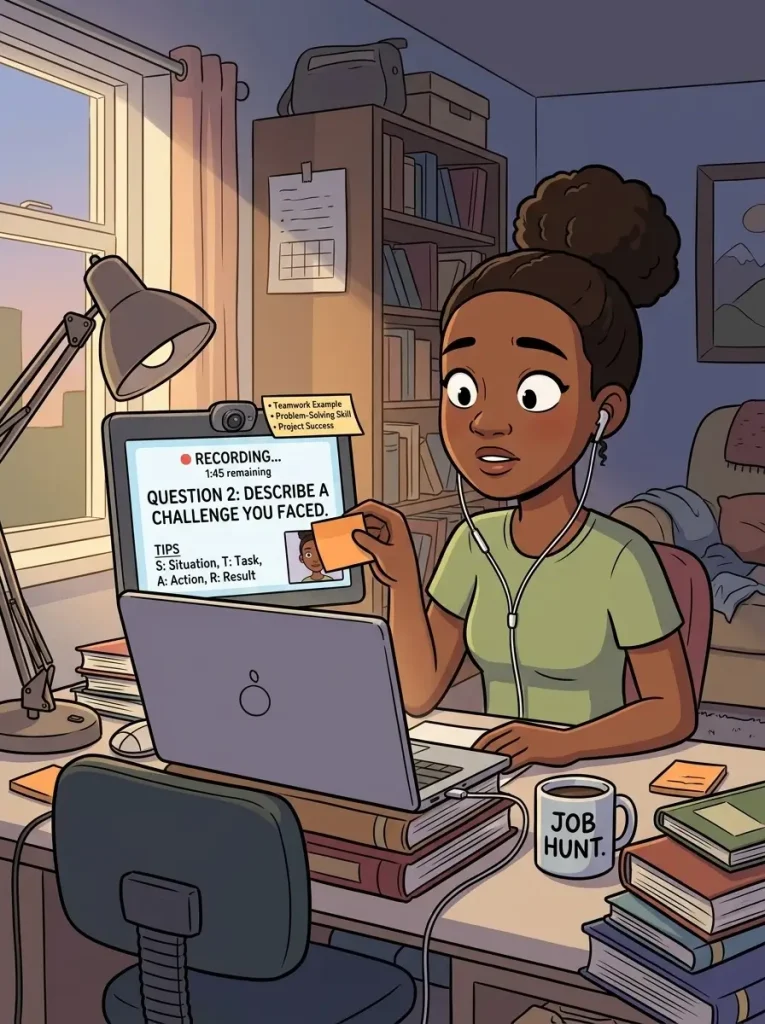
Let’s be completely honest: very few things in the modern job hunt feel as unnatural, awkward, and downright painful as staring into a cold, black camera lens and talking about your achievements.
If the phrase “Please record a 2-minute video introducing yourself” makes your stomach drop, you are not alone. In fact, you are in the vast majority. There is a deeply rooted psychological reason why most people absolutely despise recording themselves for employers, and it has very little to do with how qualified they are for the job.
If you are trying to overcome this camera anxiety, land a remote role, or simply get through your next automated application without cringing, let’s dive deep into why this happens—and explore the actionable strategies you can use to conquer it.
Why Do We Hate Recording Ourselves So Much?
To defeat camera anxiety, you first need to understand where it comes from. It isn’t just “shyness.” It is driven by three specific psychological triggers:
- The Feedback Void: In a normal conversation, you read the other person’s face. You see them nod, smile, or lean in. This constant loop of micro-signals tells your brain, “You are doing fine.” A webcam gives you absolutely nothing back. It is a one-way street that leaves your brain guessing, which triggers panic.
- The Hyper-Self-Awareness Trap: When an interview platform shows you a live preview of your own face, your brain goes into overdrive. You stop focusing on your thoughts and start analyzing your facial expressions, your hair, or how your mouth moves. You essentially become a spectator to your own performance.
- The Permanence Threat: Unlike a live conversation where words vanish into the air as soon as they are spoken, a recording feels permanent. Your brain treats the camera like a judge that is freezing your mistakes in time for strangers to analyze later.
The Technical & Mental Blueprint to Ace the Video Interview
Knowing the enemy is only half the battle. To actually stand out and appear confident, you need to set up your environment and your mind to bypass these biological panic triggers. Here is your step-by-step operational guide:
1. The Sticky Note Trick (Killing the Self-Awareness Trap)
The moment your camera turns on and you verify that you are properly framed in the center of the screen, take a physical sticky note or a small piece of paper and tape it directly over your own video preview feed.
If you cannot see yourself, you cannot critique yourself. This single action immediately forces your brain out of “spectator mode” and allows you to focus purely on the thoughts you are trying to articulate.
2. Master the News Anchor Frame
Psychology shows that humans trust people more when they can see their hands. If your camera is zoomed all the way into your face, you look like a floating head, which feels intense and aggressive.
Instead, elevate your laptop or phone on a stack of heavy books until the camera lens sits exactly at eye level. Position yourself so the frame captures you from the middle of your chest up to just above your head. This gives you natural breathing room to use subtle, confident hand gestures just like a professional news anchor.
3. Defeat the Lighting Shadow
Never sit with a bright window, lamp, or balcony behind you. This creates a silhouette effect, turning you into a dark, faceless figure. Always face your primary light source. Let the natural light hit your face directly, or place a simple desk lamp right behind your laptop screen. When an employer can see your eyes clearly, it builds immediate unconscious trust.
4. Focus on Audio Over Video
Here is a industry secret: hiring managers will forgive average video quality, but they will immediately reject a candidate with terrible, echoing audio. If they have to strain their ears to hear your answers over street traffic, fan noise, or room echo, they will lose focus.
Always use a standard pair of wired earphones with an inline microphone close to your mouth. Wired connections never suffer from Bluetooth battery lag, and they isolate your voice beautifully from background noise.
How to Structure Your Speech Without Stumbling
When you are nervous, your brain tends to wander, leading to rambling answers that run out of time. To prevent this, anchor every single response using the STAR Method. This simple structural formula keeps your answers punchy and meaningful:
| Component | What to Say |
|---|---|
| S – Situation | Set the scene briefly. (e.g., “In my last role as a local marketer…”) |
| T – Task | Explain the specific challenge or goal you faced. |
| A – Action | Detail the exact steps you took to resolve it. |
| R – Result | Share the positive outcome, using numbers if possible. |
Pro Tip: Paste a few small bullet points on a digital sticky note right next to your physical camera lens on your screen. When you look at your notes, it will look like you are maintaining direct eye contact with the interviewer rather than reading a script below your desk.
Embrace the Imperfect
At the end of the day, remember that employers are not looking to hire flawless Hollywood actors or perfect television presenters. They are looking for capable, authentic humans who can solve their business problems.
If you stumble over a word, don’t panic or panic-abort the recording. Take a deep breath, smile smoothly, say, “Let me rephrase that,” and keep moving forward. Showing that you can maintain your composure when things don’t go perfectly is a massive green flag to any hiring manager.
What is your biggest fear when it comes to recording yourself for interviews? Have you tried any tricks that worked? Let me know on LinkedIn!