
How to Transition from Job Seeker to Remote Product Manager
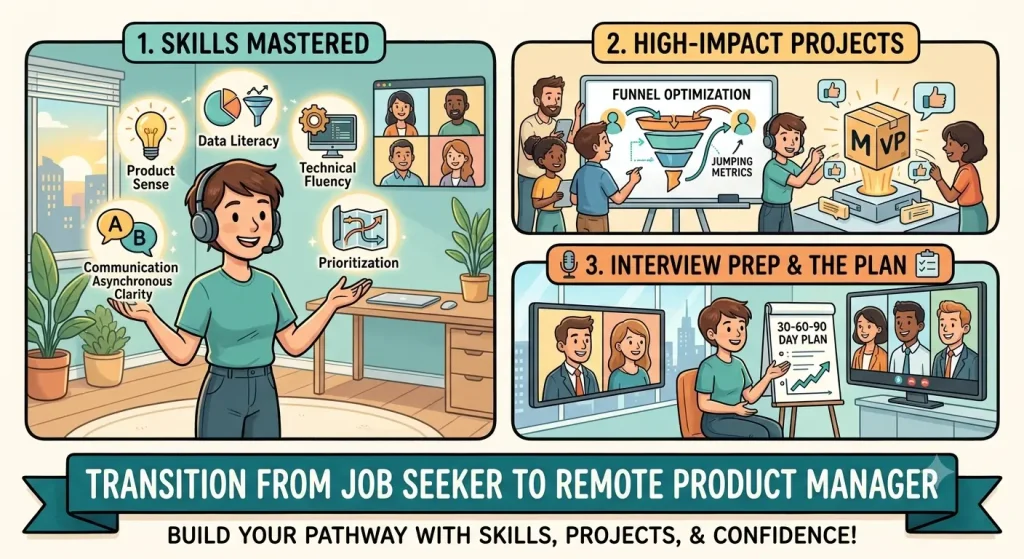
You want a remote product manager role, but your resume reads like a patchwork of jobs, projects, and hopeful buzzwords. This guide turns those fragments into a clear path. You will learn which skills hire managers actually look for, what projects prove you can ship value, and how to prepare for interviews that favor remote work.
Why remote product management is different
Remote product managers need the standard PM skills plus fluid communication habits. You will manage stakeholders across time zones, write crisp asynchronous updates, and run experiments with limited face time. Hiring teams look for evidence you can move work forward without constant supervision.
Core skills to master
- Product sense: Break down user problems, prioritize impact, and design experiments that validate outcomes. Use simple frameworks like “user problem, metric to move, minimum test.”
- Data literacy: Read metrics, analyze funnels, and craft A B test hypotheses. You do not need to be a data scientist, but you must interpret results and make tradeoffs.
- Technical fluency: Understand system constraints, API design, authentication, and basic web performance. Speak confidently with engineers about scope and effort.
- Communication: Write clear PRDs, status updates, and onboarding docs. Asynchronous clarity is a top differentiator for remote roles.
- Prioritization and roadmaps: Use lightweight roadmaps that align to measurable goals. Show how to adapt plans when new evidence arrives.
- Stakeholder management: Influence without authority, build trust, and resolve conflicts. Remote influence often happens in short, focused messages.
Soft skills that tip the scale
- Empathy for teammates and users.
- Rituals for alignment like weekly async demos.
- Discipline in calendar hygiene and focused deep work.
- Time zone etiquette and overlapping hours that match teammates.
High-impact projects to build your portfolio
Choose projects that showcase decision making, metrics, and end-to-end delivery. Each project below includes what to show and how to present it.
1. Rebuild a funnel bottleneck
Pick a product or side project with measurable dropoff. Run a hypothesis-driven experiment to reduce friction.
What to show:
- Funnel map with baseline metrics.
- Hypothesis and experiment plan.
- Implementation notes and test results.
- Post-mortem with learnings and next steps.
Why it matters:
Hiring managers want to see measurable impact and methodical thinking.
2. Launch a lightweight MVP
Build a Minimum Viable Product for a clear user problem and ship it fast.
What to show:
- One-page product brief.
- Prototype screenshots or a link.
- User feedback and usage metrics.
- Roadmap for the next three sprints.
Why it matters:
Shows you can move from idea to shipped outcome with limited resources.
3. Run a cross-functional initiative
Lead a small team to improve a shared process like onboarding, performance, or retention.
What to show:
- Stakeholder map and kickoff notes.
- Sprint plan and defined success metrics.
- Timeline and artifacts (boards, meeting notes).
- Evidence of collaboration and outcomes.
Why it matters:
Demonstrates leadership and remote collaboration skills.
4. Open source or community product work
Contribute to a community-driven product or maintain a small open source project.
What to show:
- PRs, issues resolved, or documentation improvements.
- Community interactions and communication samples.
- Metrics if your work increased adoption or reduced support load.
Why it matters:
Signals initiative, code literacy, and public collaboration.
How to structure your portfolio and resume
- Lead with impact: Use bullet points that show the outcome first. Example: Increased trial conversion 18 percent by redesigning onboarding.
- Context, action, result: One line for the problem, one for your work, one for measurable result.
- Remote signals: Include async artifacts like evergreen docs, runbooks, or recorded demos. Mention remote tools and overlap hours.
- Project pages: Create short case studies with links, charts, and clear takeaways.
- Keep it scannable: Hiring managers skim. Use bold numbers and brief headers.
Interview prep for remote product roles
Remote interviews test fit, communication, and decision style. Prepare to demonstrate process and presence.
Screening and take-home tests
- Be swift and concise. Send clarifying questions within 24 hours.
- Treat take-home tasks like a mini product case. Frame assumptions, outline a plan, and show tradeoffs.
- Provide a brief one-page summary and optional appendix with data or mocks.
Live case interviews
- Structure your answers using clear frameworks: situation, candidate role, options, recommendation, and metrics.
- Ask clarifying questions early. Use them to narrow scope and show prioritization.
- Push for measurable outcomes and specify how you would validate success.
Behavioral interviews
- Tell stories that show autonomy, remote leadership, and conflict resolution.
- Use STAR but keep it tight. Focus on impact and what you learned.
- Prepare examples where async communication prevented mistakes or accelerated delivery.
Async and written tests
- Treat written responses as a sample of your work. Be crisp, organized, and refer to artifacts.
- Use headings, bullets, and visuals when permitted.
Interview day logistics and presence
- Test tech beforehand: camera, mic, and screen sharing.
- Choose a neutral background and minimal distractions.
- Use a concise opening: one-sentence role summary, 30-second anecdote, and your remote availability.
- Mirror the interviewer tone and default to clarity when asked ambiguous questions.
Negotiation and salary signals
- Know market ranges for remote PMs by level and geography.
- Present range, not a single number, and justify with recent impact metrics.
- Ask about scope, team size, and decision autonomy as part of compensation conversations.
A 30, 60, 90 plan for remote roles
Write a short plan you can share in interviews. Focus on learning, early wins, and scaling.
- 30 days: Learn the product, meet stakeholders, and deliver one small async document that clarifies priorities.
- 60 days: Run an experiment that moves a key metric and establish regular cross-functional rituals.
- 90 days: Own a roadmap area, mentor teammates, and formalize measurement practices.
Quick checklist before applying
- Portfolio with three case studies and clear metrics.
- Resume that leads with impact and remote signals.
- Two async artifacts like a PRD and a recorded demo.
- 30 60 90 plan tailored to the company.
- Clear availability and overlap hours on your profile.
This blueprint turns scattered job hunting into a focused campaign. Execute the projects, craft concise artifacts, and rehearse interviews with remote-specific examples. The work you show will speak louder than words.